Baptist Simulation Center Uses High-Tech Tools to Help Staff Learn

April 27th, 2010 SAgranov ShareThis No comments

Source: Commercial Appeal
By Toby Sells
Posted April 27, 2010

Simulator

A package delivery driver was hit by a car last week. His heart stopped at the scene.

He was brought to Baptist Memorial Hospital-Memphis, where he was shocked back to life with a defibrillator. His condition finally stabilized, but he needed an overnight stay in the emergency room.

Sarah Eisenbacher monitors and controls SimMan 3G while nurse Ken Tate demonstrates the realistic respiration of the high-tech mannequin, which can mimic the symptoms of just about any ailment a human could have.Sarah Eisenbacher   monitors and controls SimMan 3G while nurse Ken Tate demonstrates the realistic respiration of the high-tech mannequin, which can mimic the symptoms of just about any ailment a human could have.

Most of that really didn’t happen. The patient’s job and the car accident were made up and the “patient” wasn’t a real person, but rather a pricey, high-tech simulator.

The defibrillator shocks, however, were very real — part of a training regimen designed to help medical professionals sharpen their skills.

The simulator, one of five at Baptist’s new Simulation Center, is a SimMan 3G mannequin, a completely wireless, life-sized human model designed to mimic the symptoms of just about any injury or ailment that would befall a real person.

The mannequins can cough, cry, vomit, blink, urinate, talk, sweat, show a pulse, respond to medications, have overdoses and seizures and do just about anything else a real patient can do.

The 3,600-square-foot Simulation Center, scheduled to open May 13, will have five patient rooms equipped to simulate nearly every patient service area in the hospital — childbirth, pediatrics, critical care, general medical and emergency.

The center was established with an $815,000 grant from the Baptist Foundation, with the rest funded by the hospital. The total cost of the project was not disclosed.

Everything about the center, besides the mannequins, is real, including the room size and the medical equipment and supplies. So, when Baptist’s new nurses are training or its veterans are sharpening their skills, they are not allowed to use the “p” word.

” ‘Pretend’ is a word we don’t use in here,” said Judy Bedard, Baptist’s director of staff development and a registered nurse. “We want you to simulate everything.”

Bedard said Baptist began training on mannequins in 2004, but that the new simulation center is a major step forward in that sort of training.

“There is just a lot of complexity now in just taking care of the basic situations and equipment and medications,” she said.

The Medical Education and Research Institute has been using simulators for two years, said Elizabeth Ostric, its executive director.

“We see how much (the simulators) help students at every level, whether you’re an experienced caregiver or one who is learning to become a caregiver,” Ostric said. “We see that allowing people to demonstrate their competence increases their confidence.”

The institute teaches simulated courses on advanced life support, restricted airways and many courses for paramedics in Shelby County.

Baptist’s Bedard said simulators have been around for about 10 years and have been used for years by the military and in academia, but have just recently caught on in hospital settings.

She said each of the hospital’s new high-tech mannequins cost about $65,000.

“But what they provide in the learning environment, they’re worth much more than that,” she said.

Congressman Marsha Blackburn Visits the MERI

April 25th, 2010 SAgranov ShareThis No comments

Congressman Marsha Blackburn

On Friday, April 23, Congressman Marsha Blackburn visited the MERI school to learn more about simulated hands-on training for physicians, nurses,

CRNAs, nurse anesthetists, Paramedics, EMTs, and other healthcare professionals. She was able to observe a simulated OB event and learn about the various uses of simulated hands-on training for healthcare professionals.

She observed a Paramedic Disaster drill and saw first hand the advantages of simulated trauma scenarios and how realistic the training can be. She was able to talk with Paramedics and educators and learned how valuable hands-on simulated training is to improving their skills and their ability to positively impact patient safety.

Congressman Blackburn observed hands-on training labs with physicians using anatomic donors and heard first hand from training coordinators how valuable hands-on training is to ensure that physicians are trained properly to perform minimally invasive surgical procedures.

Memphis Medical Device Sector Growing

April 19th, 2010 SAgranov ShareThis No comments

Courtesy of InvestorNation.com

Most industries are feeling the effects of the recession.  One that isn’t is Memphis’ medical device industry which is growing and expanding.  The industry in Memphis features companies like Wright Medical, Metronic, NuVasive, Onyx, and Smith & Nephew.  NuVasive recently announced a doubling of its 40,000 square-foot Memphis distribution center.  Companies like NuVasive are attracted to Memphis because of access to distribution, particularly FedEx.  Wright Medical also announced they were investing $10million to upgrade their Arlington based distribution center.

All of this comes of the heels of Memphis UT-Baptist Research Park which is currently under construction in phase 1 of a 6 phase project over the next 10 years which will add 1.2million square feet of research and education facility for the bio-medical sector of Memphis’ economy.

MemphisConnect Highlights MERI’s Disaster Training Course

March 5th, 2010 SAgranov ShareThis No comments

A big Thank You goes out to Elizabeth Lemmonds, Director of Communications and Marketing from The Leadership Academy, for writing such a great article featuring the MERI and the disaster training for EMS and Firefighter we’ve begun hosting.

A fog machine adds to the realism of this disaster scenario.

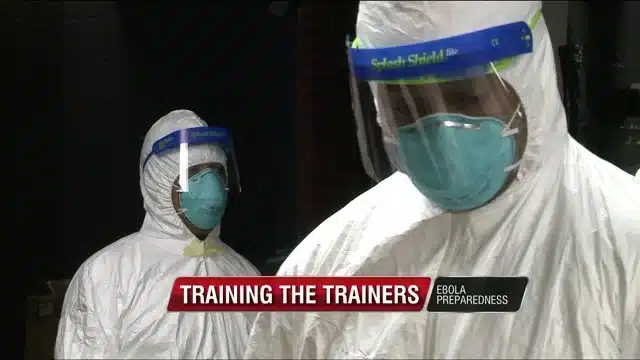
Memphis’ own Medical Education and Research Institute (MERI) is launching disaster training for EMTs and paramedics in the greater Memphis area. Another strong testament to our local medical industry: our community’s emergency workers will be armed with leading edge disaster preparedness, thanks to a first-of-its kind training and research school:

The Medical Education and Research Institute announced the launch of EMS disaster training courses which will be offered to paramedics and EMTs throughout Memphis, Shelby County and its municipalities on six separate dates: The first course will be held on December 17, 2009 with the balance to follow in the first quarter of 2010.

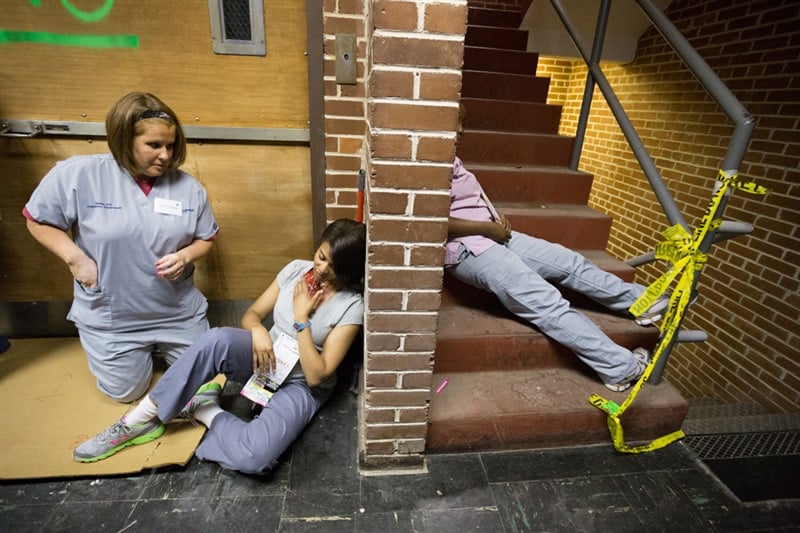
The full-day courses will focus on applying emergency medical techniques and procedures in disaster situations as it relates to treatment of injuries including victims of a simulated office complex bombing. The courses will also focus on search and rescue and triage of simulated victims during the disaster. The course will be taught by experts in the field of emergency medicine and disaster preparedness.

Actual disaster situations are simulated, like a body trapped in rubble.

“We feel that this is invaluable simulation training to offer to the Memphis and Shelby County Paramedics and EMTs, and we hope that it will be beneficial to the community in disaster relief and preparedness,” Diana Kelly, MERI Manager Institutional Development, said.

The new EMS disaster training courses are available in part as a result of a matching grant given to the MERI by the Plough Foundation to train paramedics and EMTs in Memphis, Shelby County and its municipalities. Partnering with this effort is the Department of Homeland Security Metropolitan Medical Response System Program administered through the Memphis Division of Fire Services that will also aid in funding the project.

Trainees will respond to lifelike injuries like burns and amputations.

Simulation training at the MERI was made possible by a $1 million grant from the Assisi Foundation, which funded the space, human patient simulators, and tools for the MERI Medical Simulation Center.

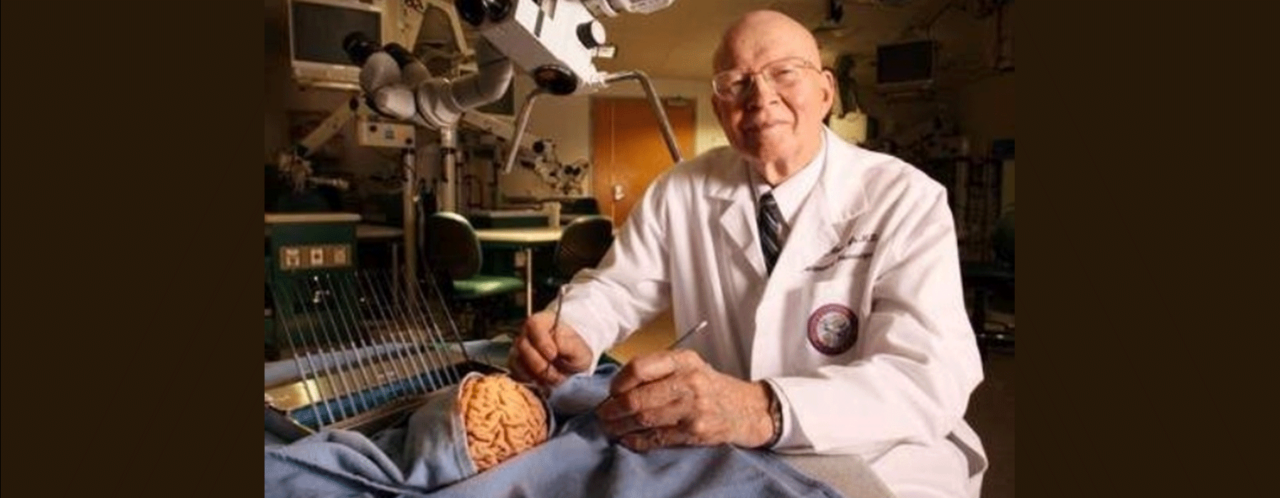
About the MERI The Medical Education & Research Institute (MERI) is a non-profit medical teaching and training school in Memphis, Tennessee, that conducts state-of-the-art, hands-on educational courses for physicians and other medical personnel from across the country and around the world. A first-of-its kind training and research school, the MERI’s use of un-embalmed anatomical donors and human patient simulators, offers physicians, nurses, nurse anesthetists, paramedics, EMTs and other healthcare professionals a unique, invaluable and authentic operating room training experience in which new techniques, technologies and devices perform just as they would on a living patient. Inspired in 1992 by Memphis neurosurgeon Kevin Foley, today the MERI educates more than 9,600 students each year from all 50 states and more than 27 countries from around the world.

*