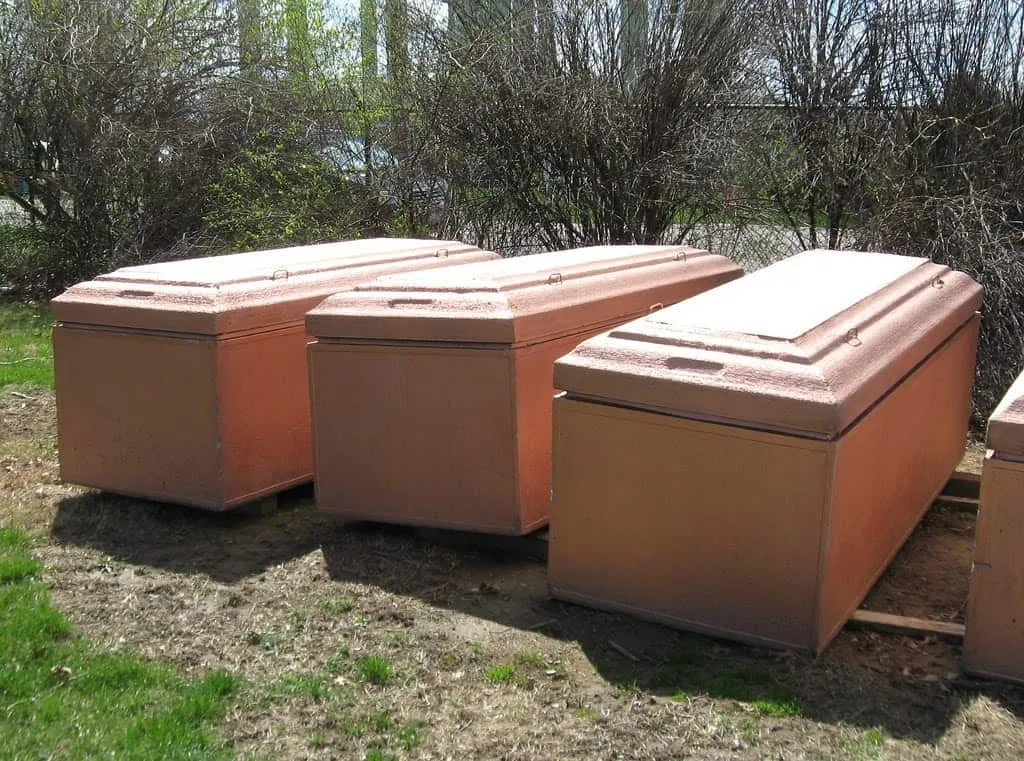

How much does a burial vault cost? A 2026 guide for families
The honest answer to how much a burial vault costs is that it depends almost entirely on a distinction most families never have explained to them. A vault can run anywhere from about $400 to well past $16,000, with the national median sitting around $1,572, and that enormous spread is not really about marble finishes or bronze. It is about the fact that two very different products get sold under nearly the same name, and that the cheaper one will usually satisfy the cemetery just as well as the expensive one. Knowing that before you walk into a funeral home is the single most useful thing on this page, and it can save you real money at a moment when money is the last thing you have the energy to fight about.
So let’s start there, because it is where the savings live.
The difference between a burial vault and a grave liner
When a cemetery tells you that you need an “outer burial container,” what they mean is that something has to go around the casket in the ground so the grave does not slowly sink as the years pass. Two things do that job, and they are not priced anywhere near each other.
A grave liner is the plainer of the two. It sits over the top and sides of the casket, keeps the ground from settling, and that is the whole of its ambition. It is not sealed, and it is the cheaper option, generally somewhere between $400 and $1,500. A burial vault does the same structural work but is fully sealed against moisture and pressure, built more heavily, and finished in materials that range from poured concrete to lined bronze. That sealing and that construction are what you pay the difference for, and the difference can be large: a sealed vault starts around $600 for a basic concrete model and climbs past $16,000 at the premium metal end.
Here is the part funeral homes do not always volunteer. In the Federal Trade Commission’s own words, “either a grave liner or a burial vault will satisfy” a cemetery’s requirement. If your family does not specifically want the sealed version, the liner often meets the rule for less, sometimes for far less. It is always worth asking the cemetery, in plain words, which one they actually require.
Does the law even require a burial vault?
This is where families overpay most, so it is worth being exact about it. No state law generally requires you to buy a burial vault at all. When the requirement exists, it comes from the individual cemetery, not from the government, and the FTC spells this out: “in most areas of the country, state or local law does not require that you buy a container to surround the casket in the grave. However, many cemeteries require that you have such a container so that the grave will not sink in.” A funeral provider is not permitted to tell you the law demands a vault when it does not.
What that means for you is one phone call. Ask the cemetery whether a grave liner satisfies their rule or whether they specifically require a sealed vault. That is the whole question. The answer can be the difference of hundreds or even thousands of dollars, and you are entirely within your rights to ask it.
What the different types of burial vaults cost
If you do decide on a vault, the price follows the material more than anything else. Concrete is the most common, and the cheapest. It runs roughly $600 to $4,000, depending on whether you pick a basic sealed model or a heavier double-reinforced one with a lined interior. Metal is where the number climbs. The steel, bronze, and copper vaults are corrosion-resistant and sit at the top of the range, from about $2,000 to $16,000 and beyond; a bronze vault from a maker like Wilbert can land between $6,300 and $13,000 on its own. Polymer and plastic fall in between. They are lightweight, highly water-resistant, and usually somewhere around $1,000 to $2,000.
There is one cost that hides at the bottom of the bill, and it surprises people: the cemetery almost always charges a separate fee to set the vault in the ground, often $100 to $250 or more on top of the price of the vault itself. It is worth asking about up front rather than discovering it later. For a sense of where all this lands nationally, the National Funeral Directors Association tracks the numbers each year, and in its most recent figures, adding a burial vault brought the median funeral with viewing and burial to about $9,995, with the vault accounting for roughly $1,695 of it.
Beyond the material, the things that move the number are about what you would expect. A basic unlined model sits at the floor; lining, reinforcement, color, and personalization all push it up, sometimes steeply at the high end. Where you live and which funeral home or cemetery you use matters too. And if the cemetery happens to require a sealed vault specifically, that quietly removes the cheaper liner from the table. But the biggest lever, every time, is still the first one: whether you genuinely need a sealed vault or whether a liner will do.
Ways to bring the cost down, or skip it entirely
If the number feels heavy, you have more room than the price list in front of you suggests. The simplest move is the one already mentioned, asking whether a liner satisfies the cemetery instead of a full vault. Beyond that, home or family-land burial, where it is legal, has no cemetery and therefore no vault requirement at all, though the rules vary by state and county and you will want to check yours. Green and natural burial grounds are often designed without vaults on purpose, since the whole idea is to let the ground return to itself. And then there is whole body donation, which removes this entire cost and most of the others along with it. If you are comparing options, it is worth understanding what direct burial involves, the types of cemetery plots and their costs, and how cremation costs compare to burial before you commit to anything, and prepaid planning if you would rather settle the details ahead of time.
When body donation makes the vault question disappear
For families who are open to it, whole body donation takes the vault question off the table completely, because there is no plot to fill and nothing to bury. Through the Genesis Whole Body Donation Program, the program covers transportation, the death certificate, and cremation at no cost to the family, and the cremated remains are returned to you afterward. No casket, no vault, no setting fee.
It is a deeply personal decision and the right one for some families and not for others, which is exactly as it should be. But for those weighing it, it turns a final arrangement into something that also gives to medical education and research, and it lifts a real financial weight off the people left behind. If you want to see how the pieces fit together, this is a fuller look at how body donation helps with funeral costs.